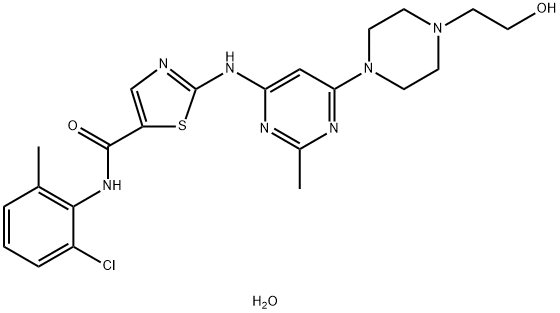
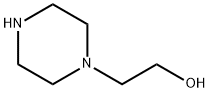
General procedure: to a mixture of N-(2-chloro-6-methylphenyl)-2-[(6-chloro-2-methyl-4-pyrimidinyl)amino]-5-thiazolecarboxamide (4.00 g, 10.14 mmol) and N-hydroxyethylpiperazine (6.60 g, 50.69 mmol) in n-butanol (40 mL) was added N,N-diisopropylethylamine (DIPEA, 3.53 mL, 20.26 mmol). The reaction mixture was heated with stirring at 118 °C for 4.5 h, followed by slow cooling to room temperature. The precipitated solid was collected by vacuum filtration and washed with n-butanol (5 mL) and subsequently dried. The crude product (5.11 g) was dissolved in hot 80% ethanol-water (80 mL) and the solution was clarified by filtration. The hot filtrate was slowly diluted with water (15 mL) and slowly cooled to room temperature. The precipitated solid was collected by vacuum filtration, washed with 50% ethanol-water (5 mL) and dried to afford N-(2-chloro-6-methylphenyl)-2-((6-(4-(2-hydroxyethyl)-1-piperazinyl)-2-methyl-4-pyrimidinyl)amino)-5-thiazolecarboxamide hydrate 4.27 g in 83.2% yield.1H NMR (400 MHz, DMSO -d6) δ 2.23 (s, 3H), 2.40 (s, 3H), 2.42 (t, 2H, J = 6 Hz), 2.48 (t, 4H, J = 6.3 Hz), 3.50 (m, 4H), 3.53 (q, 2H, J = 6 Hz), 4.45 (t, 1H, J = 5.3 Hz), 6.04 (s, 1H), 7.25 (t, 1H , J = 7.6 Hz), 7.27 (dd, 1H, J = 7.6, 1.7 Hz), 7.40 (dd, 1H, J = 7.6, 1.7 Hz), 8.21 (s, 1H), 9.87 (s, 1H), 11.47 (s, 1H).



![N-(2-Chloro-6-methylphenyl)-2-[(6-chloro-2-methyl-4-pyrimidinyl)amino]-5-thiazolecarboxamide](/CAS/GIF/302964-08-5.gif)
